March 31, 2010

Residents Go Shopping!

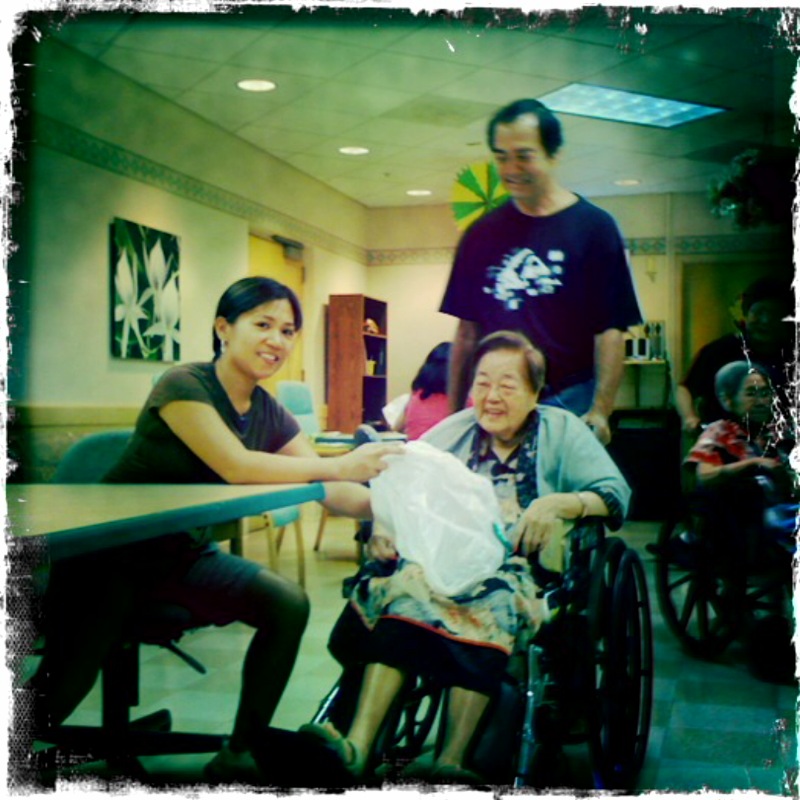
Today residents at both Hale Makua communities spent the morning doing some serious shopping.The craft and food sales were held on-site so that all residents could come to pursue and make purchases at their leisure. Food items included everything from fresh produce to banana lumpia, laulau, kalua pig, pancit, chow fun, and many baked sweet treats. Crafts varied from handmade jewelry to knit caps and intricate quilts.There were even potted lilies for sale. No one left empty handed.

I stopped Burno Wong to checkout his purchases, which consisted only of fresh produce - bell peppers, eggplant and garlic for a dish he was planning to make later. Ben Corniel bought a ton of food, literally, his shopping bag was really heavy with all of the musubi and cone sushi. Gloria Distefano picked out a my favorite knit cap made with a fabulous fuchsia, aqua and pink yarn. I even ended up buying some yummy boiled peanuts that the girls in Activities made.

The majority of the proceeds from the sale help to buy things for the residents, like bingo prizes, plants for gardening, etc.

March 30, 2010

Take a Walk in the Park Day Celebrated

Today, March 30th, is Take a Walk in the Park Day. Residents who wanted to enjoy a nice stroll in the sun ventured out into the sunny, albeit a bit blustery, afternoon in celebration of Take a Walk in the Park Day.

Studies have shown that taking a walk in a park a day keeps mental fatigue away
.Psychologists Marc G. Berman, John Jonides, and Stephen Kaplan from the University of Michigan designed two experiments to test how interactions with nature and urban environments would affect attention and memory processes. First, a group of volunteers completed a task designed to challenge memory and attention. The volunteers then took a walk in either a park or in downtown Ann Arbor. After the walk, volunteers returned to the lab and were retested on the task. In the second experiment, after volunteers completed the task, instead of going out for a walk, they simply viewed either nature photographs or photographs of urban environments and then repeated the task.

The results were quite interesting. In the first experiment, performance on the memory and attention task greatly improved following the walk in the park, but did not improve for volunteers who walked downtown. And it is not just being outside that is beneficial for mental functions—the group who viewed the nature photographs performed much better on the retest than the group who looked at city scenes.

The authors suggest that urban environments provide a relatively complex and often confusing pattern of stimulation, which requires effort to sort out and interpret. Natural environments, by contrast, offer a more coherent (and often more aesthetic) pattern of stimulation that, far from requiring effort, are often experienced as restful. Thus being in the context of nature is effortless, permitting us to replenish our capacity to attend and thus having a restorative effect on our mental abilities.

Excerpt from Science Daily, December 23, 2008

March 29, 2010

Eden Alternative Tip of the Week: Education on the Eden Alternative Journey

There are three stages to implementing the Eden Alternative. First the vision of where the journey can take you needs to be defined. Then education needs to happen so that people are prepared to be engaged in the journey toward the vision. Lastly, there needs to be a plan that is implemented. Although it might sound like a straight-forward process, there are actually many twists and turns through the three stages during the implementation of any change along the Eden journey. You are constantly bouncing between vision, education and implementation until the change is completed and "hard wired" into place.

All three stages are important. One without the other two will not lead to success. The one stage that is continuous and ongoing is the education stage. Education is the antidote to fear and resistance along the journey. It is a key ingredient in successful empowerment and engagement of everyone. Without education, nothing will change. People need to understand what to do, how to do it and why it is important.

More than that, they need to have a reason to apply what they have learned as quickly as possible. They need to put the education to use and if possible have the experience of teaching it to someone else as well. That is how adults learn. When you conduct those all-staff inservice education programs, how do you go about assuring that the information is put into action right away? If you are teaching a new skill, you might run some practice sessions with small groups of participants. If you are teaching a new way of thinking, you might hold some learning circles to help people process what they have learned or set expectations that put the new information into action quickly. You might go back a week or so after the inservice and do some interviews to see what people remember about what was covered and how they have applied the learning. Sometimes new education can be woven into the performance evaluation process as a goal or expectation so that people understand what they are to do with the new knowledge.

Education of everyone on the Eden Alternative Philosophy is important along the journey. More than just covering the basics on the Ten Principles, people need to understand how to put the Principles into action. One way to help capture what that might look like is to use the slide show presentation that comes on the Haleigh's Almanac CD. Modify the presentation by building in your home's mission, vision and pictures of life that relate to the Principles. Show it to others (within and outside the home) so they can see the vision of what is possible, not just always hear the words. A great example is a slide show from Christa Monkhouse, International Regional Coordinator from Europe. She captures the essence of life that is important to capture people's hearts and open their minds.

Education is a valuable resource and tool to use along the Eden journey. Make it real, applicable, timely and something you continually evaluate along the way. Help answer the question that is on everyone's mind: What's in it for me if I get involved? When you can answer that, you are halfway home.

March 26, 2010

What is the Thinking Organ

Our brain is a thinking organ that learns and grows by interacting with the world through perception and action. Mental stimulation improves brain function and actually protects against cognitive decline, as does physical exercise.

The human brain is able to continually adapt and rewire itself. Even in old age, it can grow new neurons. Severe mental decline is usually caused by disease, whereas most age-related losses in memory or motor skills simply result from inactivity and a lack of mental exercise and stimulation. In other words, use it or lose it. And that is exactly what the Hale Makua Wailuku residents did during our version of Jeopardy. Residents chose from various topics that gave them the chance to jog their brains and answer the trivia.

Photos: “I’ll take the United States for 200”…” We are the last 2 states. We do not touch any other states”…”What is Alaska and Hawaii, and calling on my inner Alex Trebek

Submitted by: Lynsey Capone, Activities Director


March 25, 2010

Painting with Marie

Every other month an art instructor comes to Hale Makua Kahului to teach painting classes. During the two to two and a half hour painting class, residents are taught painting techniques and complete an entire painting on their own. The oil on canvas paintings are then framed and displayed in the Weinberg entrance to Hale Makua. We have some very talented painters at Hale Makua.

According to MyOptumHealth.com some of the therapeutic benefits of art can include:
  • Self-healing. Art therapy can help you come to terms with your feelings by identifying and working through anger, resentment and other emotions. This is especially helpful during or after a traumatic incident or illness. In this way it may restore or refresh your spirit.
  • Personal fulfillment. Creating a piece of art can build confidence and nurture feelings of self-worth.
  • Empowerment. Art therapy can help you express emotions and fears you may not be able to say with words. This can give you some sense of control over your feelings.
  • Relaxation and stress relief. Chronic stress can harm both mind and body. Art therapy can be used alone or together with other relaxation techniques to help relieve stress and anxiety.
  • Symptom relief. Art therapy may also help you cope with pain. It can be prescribed to accompany pain control therapy for chronically and terminally ill patients.

March 23, 2010

My First Resident Council Meeting

Yesterday afternoon I was was thrilled to have been invited to speak about some of our new social marketing tools and the quarterly resident newsletter at our Kahului community's Resident Council. With the newsletter, Ho'olaha, I had never in the almost two years that I've been working at Hale Makua Health Services asked residents what they would like to read about in their newsletter, if the font size is large enough, or if they liked to 8.5" x 11" size. The overall consensus was that the current newsletter is a good size and the stories were liked.

Vilma Sanchez can up with the excellent idea of adding a word find puzzle to the newsletter, much like the newspaper's crossword and sodoku puzzles. This way residents would have something else to do with the newsletter once they're done reading it. The other members of the Resident Council agreed that they liked this idea. So the upcoming Spring '10 issue of Ho'olaha will now include a word find puzzle in addition to the stories about what they've been doing in their Hale Makua communities.

Roberta Kapuaala also have the great suggestion of including residents' birthdays in the newsletter so that they would know whose birthday is coming up.

Sewing Classes

Residents gather once a month to sew various items such as lap blankets, pillow cases, wheel chair and walker bags, and eye glass cases. These items are then put into the bingo store for residents to purchase with the money that they win from playing bingo. Today residents worked on making pillow covers.

Pictured below are Roberta Kapuaala at the sewing machine and Clara Correa picking fabrics for the pillow cover she's making.

Submitted by: Teresa Lopes, Activities Director

March 22, 2010

Ethnic Cooking with Chef Thomas

Last week Friday the residents of Hale Makua Kahului were treated to an onolicious dish of Chicken Hekka prepared by fellow resident Joe Thomas. Joe's Chicken Hekka dish was prepared for a recipe that he learned from his mother. It's an Asian stir fry that includes chicken, bamboo shoots, shitake mushrooms, long rice, soy sauce, sake, green onion, ginger, and sugar. It is typically served with white rice.

March 19, 2010

Eden Alternative Tip of the Week from the Book "Dementia Beyond Drugs"

Excerpts from the "Other Eyes" chapter of Dementia Beyond Drugs by Dr. Allen Power

The biomedical model sees dementia mostly as neuropathology. However, viewing only what can be easily observed and measured is inadequate to our needs. ... one can say that the physical and chemical changes that occur in the brain are of no consequence until they are
experienced by the person with the changing brain.

That experience is more than simple structural and chemical defects; many other factors come into play such as life history, relationships, values, interactions, and coping styles. Seeing dementia as a life experience and viewing the world through those eyes is the key to better understanding the needs of people with dementia.


The biomedical model sees dementia as an irreversible, progressive, and ultimately fatal disease. The experiential model sees dementia as a shift in the person's perception of his or her world. The brain, while altered, remains somewhat plastic and is intimately tied to the surrounding environment. In fact, in many cases, individuals with dementia are more exquisitely sensitive to the attributes of their surroundings than the rest of us tend to be. ... the experiential model holds that new learning can occur. .. The experiential view sees dementia as a challenge to make meaningful connections and improve the lives of all who live with the condition.


The biomedical view sees people with dementia as a burden and creates care environments that foster dependence. Biomedical dementia requires
caregivers. The experiential view sees people for the gifts and abilities they continue to express to others. Experiential dementia creates care partnerships that empower all and maximize interdependence.

... the experiential model holds that well-being is not a function of cognitive skills, and that people may retain complex and integrative abilities far into their lives with dementia. People with dementia always remain unique individuals, and this uniqueness should be the driving force in their lives and their care. Autonomy should be preserved as far as possible.


Order your copy of
Dementia Beyond Drugs from the Eden Alternative online store (www.edenalt.org) to learn more.

Musical Enjoyment Never Ends

Studies have shown that musical perception, sensibility, emotion, and memory can serve us long after other forms of memory have disappeared as we age. We have found this to be true among our residents at Hale Makua Wailuku. Our residents enjoy a good tune and appreciate an uplifting beat to put a smile on their face if for no other reason than it makes them happy. It is for these reasons that we were thrilled to welcome Angie Carr yesterday afternoon.

Angie has been performing on the piano for over 20 years. Raised in a musically talented family, she received her BA in Piano Performance and Pedagogy at Bethel College, with a minor in Saxophone performance. She also received her Master's degree in Pia
no Performance and Composition from Western Michigan University.

Throughout Angie's career, she has always been active in the community by teaching privately, playing for weddings, receptions, church services, and banquets, as well as accompanying local choirs, vocalists, and instrumentalists. Angie has performed may solo recitals and other musical performances, including Carnegie Hall.

It was a heart warming experience to see the faces of our residents, and the enjoyment that they receive from hearing a musical performance by Angie Carr. Mahalo Angie for taking the time to perform for our kupuna!


To learn more about Angie's music please visit: http://www.wix.com/angiedelight/music


Pictured below is Angie playing the saxophone, and residents Henry Kaina and Myra Yanagihara visiting with Angie

Submitted by Lynsey Capone, Activities Director