 Residents gathered in the Aloha Cafe this afternoon to learn more about healthy foods for diabetics. Guest speaker, Linda Powley, from Kaiser Permanente came to educate and answer questions.
April 19, 2010
Residents Learn About Diabetes
Residents gathered in the Aloha Cafe this afternoon to learn more about healthy foods for diabetics. Guest speaker, Linda Powley, from Kaiser Permanente came to educate and answer questions.

Watching the Fishes Swim
 This afternoon resident Lucy Demello and volunteer Sharloma Cleveland take a moment to watch the fishes swim at Hale Makua Kahului's fish pond and waterfall.
April 16, 2010
We Sing, We Dance
 Yesterday afternoon the residents and staff at Hale Makua Wailuku held Hale Makua Idol, a fundraiser for the annual Visitor Industry Charity Walk. Contestants sang their hearts out for the audience and judges, while a few audience members danced along to the tunes and held up signs for their favorite contestants.


April 12, 2010
Eden Alternative Tip of the Week: The Three Plagues of Loneliness, Helplessness & Boredom
Principle #1: The Three Plagues of loneliness, helplessness and boredom account for the bulk of suffering among our Elders.
The key word here is "bulk." This is a strong statement. It says that on a day-to-day basis, people in nursing homes suffer more from these plagues of the spirit than they do from their medical illnesses.
And that's a problem. It's a problem because we have created a model of care that primarily sees and treats medical illness. This model does not have an answer for these plagues; in fact it often contributes to them.
All of these plagues are painful, and they are all deadly. The first task of Eden is to recognize these plagues: know what they look like and how they manifest in medical illness, behavioral expressions and loss of well-being. Then we must create a new model of care - an alternative - to the model we have embraced for so many decades.
You can't do this halfway. Ever since Eden set the bar twenty years ago, organizations have been trying to tweak the medical model to accomplish true change - and have failed.
When an Edenizing organization comes to any critical decision point, it's like a Chutes and Ladders game. The culture change way is the ladder. We don't always feel like we have the energy to climb it. It's so much easier to "hop on the slide" that the old, institutional path offers us. But the slide takes us back toward the place where we started. Only the ladder - the hard road - will get us to our goal of eliminating the Three Plagues.
Don't pretend they don't exist in your home. Work to eliminate them. It's the best work we can do.
The key word here is "bulk." This is a strong statement. It says that on a day-to-day basis, people in nursing homes suffer more from these plagues of the spirit than they do from their medical illnesses.
And that's a problem. It's a problem because we have created a model of care that primarily sees and treats medical illness. This model does not have an answer for these plagues; in fact it often contributes to them.
All of these plagues are painful, and they are all deadly. The first task of Eden is to recognize these plagues: know what they look like and how they manifest in medical illness, behavioral expressions and loss of well-being. Then we must create a new model of care - an alternative - to the model we have embraced for so many decades.
You can't do this halfway. Ever since Eden set the bar twenty years ago, organizations have been trying to tweak the medical model to accomplish true change - and have failed.
When an Edenizing organization comes to any critical decision point, it's like a Chutes and Ladders game. The culture change way is the ladder. We don't always feel like we have the energy to climb it. It's so much easier to "hop on the slide" that the old, institutional path offers us. But the slide takes us back toward the place where we started. Only the ladder - the hard road - will get us to our goal of eliminating the Three Plagues.
Don't pretend they don't exist in your home. Work to eliminate them. It's the best work we can do.
By Dr. Allen Power, Eden Mentor, St. John's Home, Rochester, N.Y.,
Associate Professor of Medicine, University of Rochester
Associate Professor of Medicine, University of Rochester
April 8, 2010
Residents Highlight of Donor Recognition
Last week Thursday we recognized several of our major donors at Hale Makua Kahului with the help of some residents. Helen Oliveira and Wally Ohiro graced the crowd with some the hula. Joe Thomas spoke about how much Hale Makua has helped him in recovering after he had a stroke. Rehab by Hale Makua has helped him so much that he is now able to stand up again, and his hope is that he'll be able to move from Hale Makua to Hale Mahaolu, where he can live independently in senior housing with the help of Maui PACE. Nancy Kawamura talked about how Hale Makua has become her home and her second family. She really enjoys the friends that she's made and the painting classes. Mahalo to all of the donors whose support and dedication helps to enrich the lives of residents at Hale Makua.


April 7, 2010
The New Look of Luana
 In developing the curriculum for training all Hale Makua Health Services' employees the Luana Core Team thought it would be a great idea to have something that would reinforce the Eden Principles. We threw around ideas like having a quick reference card or a "flash card" for each principle, but those things didn't really seem realistic for staff to carry around with them. Plus we wanted something a little more fun, something that would not only serve as a reminder and reinforcement of Luana, but would also instill pride. Someone came up with the idea of having a tee shirt with the three plagues of loneliness, helplessness and boredom. While that message was quick and to the point, we wanted something more positive. In the end we decided on a message with the antidotes to the three plagues: companionship, giving & receiving care, and variety & spontaneity. The shirts will be given to each resident, employee, volunteer, and resident family member that completes the introductory Luana education. If you want to see what the tee shirt design looks like, you'll have to take the class!
In developing a simple tee shirt design the above logo was created to symbolize Luana. The vibrant blue and green colors were selected to reflect the vitality and life that resides within the Hale Makua communities, as well as the lush green courtyards and beautiful blue skies that we see almost daily here on Maui. The flower mark has a feeling of motion moving from the center outward, representing the continuous change and growth of Luana within our organization. The flower shape pays tribute to the Eden Alternative concept of growing a garden.
April 5, 2010
The Hunt is On!
On Good Friday Hale Makua Wailuku residents got a jump start on Easter by participating in an Easter egg hunt. Staff members hid eggs throughout the courtyard and gardens for residents to find. Several family members joined residents in their search for the brightly colored eggs. Residents left with baskets full of goodies and smiles on their faces.
Top photo: Resident Masaki Matsui hunts for eggs in the planter boxes with the assistance of Susie Lising
Middle photo: Resident Mitsue Nakahashi makes a grab for an Easter egg with Donna Gamurot looking on
Bottom photo: Resident Nonna Yalon shows off her collection of Easter eggs


Top photo: Resident Masaki Matsui hunts for eggs in the planter boxes with the assistance of Susie Lising
Middle photo: Resident Mitsue Nakahashi makes a grab for an Easter egg with Donna Gamurot looking on
Bottom photo: Resident Nonna Yalon shows off her collection of Easter eggs


Eden Alternative Tip of the Week: The Magic of Children & Elders
In his book, Life Worth Living, Dr. William Thomas speaks to the incredible opportunity that those who provide home for the Elders have to connect with their community's children in a manner that brings growth for the children and the Elders. "Nursing home residents are isolated from their communities because of age and capabilities. Children are removed from the life of the community for the same reasons. Within the nursing home, administrators seek to boost efficiency by sorting and grouping residents with similar problems. Likewise, the grade system is often more about administration than education. To the extent that the lives of residents and children are defined by their respective institutions, we have failed in the primary mission of educating the young and caring for the old."
"Children ... are good for older people. The hubbub they so naturally create injects vitality into any environment. Their play, laughter and song are potent medicines for the elderly. The oceans of time and painful need for companionship that most residents possess become assets to children who become a part of daily life in the nursing home. Among older people, nursing home residents have the greatest need for a connection with children, but they are least likely to have access to them."
It is not enough to have local children come in to entertain the Elders or create a craft project periodically. As one of the elements of the Human Habitat, children need to be an important part of the Elders' daily lives and both must be able to grow because of that connection. Some examples of how homes have taken steps to truly weave children into the daily lives of the Elders include:
This list goes on and on, but the common theme is that the Elders and children find connection and common purpose together. That is how the Elders find the antidotes they need for the Three Plagues and the children get the social and life skills they need to be successful. One of the Alliances for the Eden Alternative is the Macklin Intergenerational Institute. They have a wonderful approach to bringing Elders and children together in a meaningful way. Check out this power point that explains how they accomplish this.
If you would like to bring children into your Human Habitat in a more meaningful way, connect with the Macklin Intergenerational Institute and learn more about how they can assist you on your journey.
"Children ... are good for older people. The hubbub they so naturally create injects vitality into any environment. Their play, laughter and song are potent medicines for the elderly. The oceans of time and painful need for companionship that most residents possess become assets to children who become a part of daily life in the nursing home. Among older people, nursing home residents have the greatest need for a connection with children, but they are least likely to have access to them."
It is not enough to have local children come in to entertain the Elders or create a craft project periodically. As one of the elements of the Human Habitat, children need to be an important part of the Elders' daily lives and both must be able to grow because of that connection. Some examples of how homes have taken steps to truly weave children into the daily lives of the Elders include:
- On-site day care centers where the children spend time with the Elders and the Elders come in to help care for the children
- Kindergarten classes in the home where the Elders help tutor the children through reading, listening, writing and shared art and science projects.
- Before and after school programs where the school bus picks up and drops off children throughout the day
- Elders helping in the classrooms of local schools
- Elders teaching classes at local community colleges
- Youth coming in regularly to capture the Elders' legacies
This list goes on and on, but the common theme is that the Elders and children find connection and common purpose together. That is how the Elders find the antidotes they need for the Three Plagues and the children get the social and life skills they need to be successful. One of the Alliances for the Eden Alternative is the Macklin Intergenerational Institute. They have a wonderful approach to bringing Elders and children together in a meaningful way. Check out this power point that explains how they accomplish this.
If you would like to bring children into your Human Habitat in a more meaningful way, connect with the Macklin Intergenerational Institute and learn more about how they can assist you on your journey.
March 31, 2010
Residents Go Shopping!
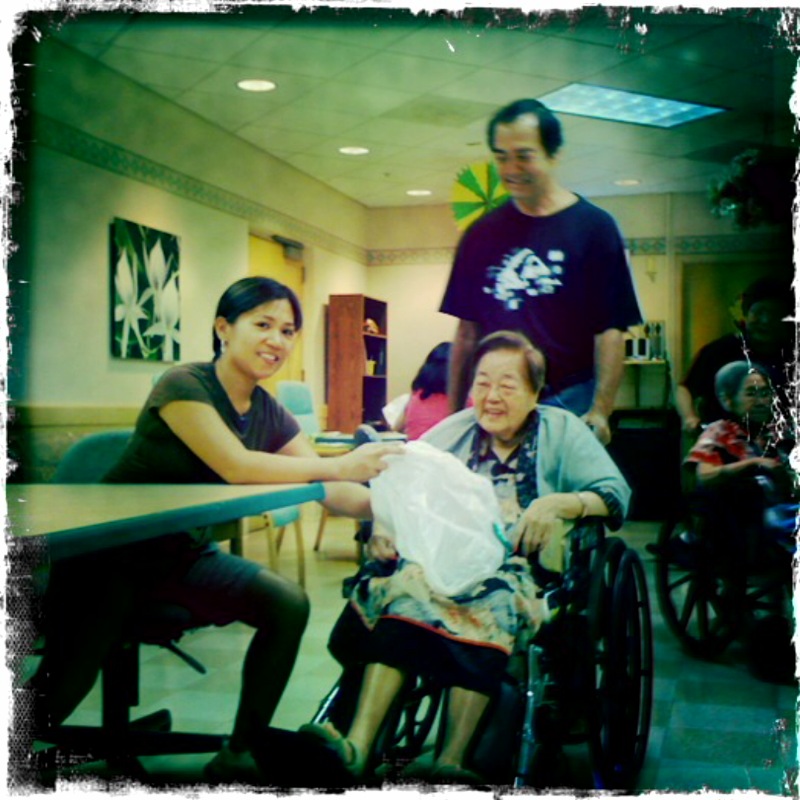 Today residents at both Hale Makua communities spent the morning doing some serious shopping.The craft and food sales were held on-site so that all residents could come to pursue and make purchases at their leisure. Food items included everything from fresh produce to banana lumpia, laulau, kalua pig, pancit, chow fun, and many baked sweet treats. Crafts varied from handmade jewelry to knit caps and intricate quilts.There were even potted lilies for sale. No one left empty handed.
I stopped Burno Wong to checkout his purchases, which consisted only of fresh produce - bell peppers, eggplant and garlic for a dish he was planning to make later. Ben Corniel bought a ton of food, literally, his shopping bag was really heavy with all of the musubi and cone sushi. Gloria Distefano picked out a my favorite knit cap made with a fabulous fuchsia, aqua and pink yarn. I even ended up buying some yummy boiled peanuts that the girls in Activities made.
The majority of the proceeds from the sale help to buy things for the residents, like bingo prizes, plants for gardening, etc.
March 30, 2010
Take a Walk in the Park Day Celebrated
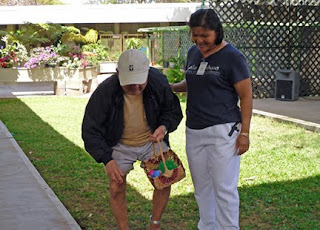
 Today, March 30th, is Take a Walk in the Park Day. Residents who wanted to enjoy a nice stroll in the sun ventured out into the sunny, albeit a bit blustery, afternoon in celebration of Take a Walk in the Park Day.
Studies have shown that taking a walk in a park a day keeps mental fatigue away.Psychologists Marc G. Berman, John Jonides, and Stephen Kaplan from the University of Michigan designed two experiments to test how interactions with nature and urban environments would affect attention and memory processes. First, a group of volunteers completed a task designed to challenge memory and attention. The volunteers then took a walk in either a park or in downtown Ann Arbor. After the walk, volunteers returned to the lab and were retested on the task. In the second experiment, after volunteers completed the task, instead of going out for a walk, they simply viewed either nature photographs or photographs of urban environments and then repeated the task.
The results were quite interesting. In the first experiment, performance on the memory and attention task greatly improved following the walk in the park, but did not improve for volunteers who walked downtown. And it is not just being outside that is beneficial for mental functions—the group who viewed the nature photographs performed much better on the retest than the group who looked at city scenes.
The authors suggest that urban environments provide a relatively complex and often confusing pattern of stimulation, which requires effort to sort out and interpret. Natural environments, by contrast, offer a more coherent (and often more aesthetic) pattern of stimulation that, far from requiring effort, are often experienced as restful. Thus being in the context of nature is effortless, permitting us to replenish our capacity to attend and thus having a restorative effect on our mental abilities.
Excerpt from Science Daily, December 23, 2008
Subscribe to:
Posts (Atom)